Quick Answer
Interlocking rubber flooring can be a practical modular option for UAE gyms, fitness rooms and other impact-sensitive spaces, but there is no single “best” thickness. The right specification depends on activity, dropped-weight exposure, acoustic sensitivity, product construction, subfloor conditions and tested performance. UAE products also vary materially in price and thickness, so compare exact products, installation scope and supporting technical documents rather than relying on labels such as “heavy-duty,” “anti-slip” or “fire-resistant.”
Key Takeaways
- Thickness is not a performance rating by itself; construction, density, impact exposure and tested build-up matter too.
- “Interlocking” does not always mean adhesive-free. Installation requirements vary by product and project.
- Different gym zones may justify different flooring specifications, especially where dropped weights or noise-sensitive occupancies are involved.
- September 2026 UAE advertised prices vary substantially between named products, so a simple AED/m² comparison can be misleading.
- Slip, acoustic, impact and fire claims should be supported by product-specific test data rather than marketing adjectives.
- For consultant and commercial projects, collect the technical submittal before approval, including relevant fire, slip, impact, acoustic, emissions, installation and maintenance documentation.
What Is Interlocking Rubber Flooring?
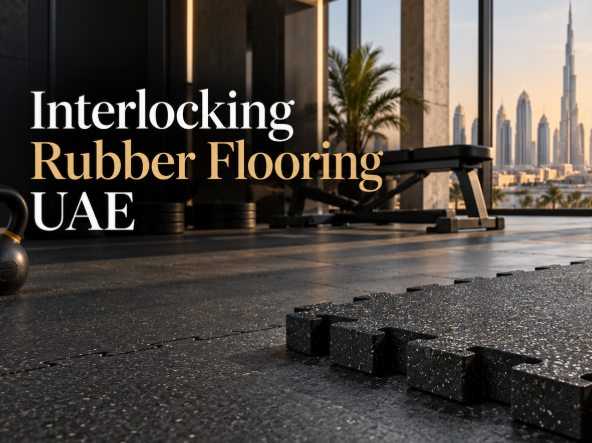
Interlocking rubber flooring is made from modular tiles designed to connect mechanically, usually through puzzle-shaped edges, dowels or another locking geometry. The format is common in gyms because individual tiles can be positioned, removed and replaced without treating the entire room as one continuous sheet.
That modularity is useful when a facility expects local wear, future equipment changes or partial repairs. A damaged tile may be easier to replace than a section cut from a large bonded roll.
But “interlocking” describes how the tiles connect. It does not tell you how much impact the floor can tolerate, how much sound it will reduce, whether adhesive is required, or whether the product is suitable for a particular fire or life-safety requirement.
Fab Floorings lists UAE interlocking gym tiles in 15, 20, 25, 30 and 40 mm options, while REGUPOL offers an engineered puzzle-format product at 8 mm and heavy modular fitness systems from Dinoflex extend to roughly 70 mm.
These products should not be treated as equivalents simply because they all use modular construction.
For buyers who first need the broader material context, Royal Floors also provides a broader guide to rubber flooring in the UAE.
Interlocking Tiles vs Rubber Rolls
The first decision is often not thickness. It is format.
Neither tiles nor rolls are automatically superior. The better choice depends on how the room will be used, repaired and maintained.
| Decision factor | Interlocking tile | Rubber roll |
| Local replacement | Strong advantage because individual modules can often be changed | Repairs may involve cutting or replacing a larger section |
| Temporary or reconfigurable installation | Often attractive | Usually less convenient |
| Number of joints | More visible joints | Fewer joints across large areas |
| Large continuous spaces | Requires careful layout | Often attractive for visual continuity |
| Heavy-impact zones | Must verify the actual product/system | Must verify the actual product/system |
| Acoustic performance | Assembly-dependent | Assembly-dependent |
| Installation | May be loose-laid or bonded, depending on product | Commonly follows manufacturer-specific installation requirements |
| Irregular walls and columns | Individual tiles can be cut to fit | Rolls also require cutting and seam planning |
Interlocking tiles have a clear modular-replacement advantage, while rolls can reduce the number of joints across larger areas; neither format is automatically the better acoustic or impact solution.
Neither format should be chosen from appearance alone. Impact exposure, movement, edge restraint, transitions, cleaning, subfloor condition and acoustic targets still need to be considered.
How Thick Should Interlocking Rubber Flooring Be?
There is no defensible universal rule that a certain thickness is always enough for a specific gym.
Thickness matters, but so do:
- material density;
- tile construction;
- surface layer;
- underside geometry;
- equipment loads;
- frequency of dropped weights;
- drop height;
- subfloor construction;
- acoustic sensitivity;
- manufacturer test data.
Some supplier guidance divides gym flooring into broad use bands. One UAE source suggests approximately 4–8 mm for cardio, yoga or lower-impact functional areas; 8–15 mm for more general free-weight use; 20–25 mm for commercial dropped-barbell areas; and 30–40+ mm for heavier Olympic or platform applications.
Those 4–8 mm, 8–15 mm, 20–25 mm and 30–40+ mm bands are supplier guidance examples, not universal engineering guarantees.
The evidence also includes an 8 mm engineered puzzle product, UAE interlocking ranges from 15 to 40 mm, and much thicker modular fitness systems. This is why “interlocking rubber flooring” is not one fixed construction.
UAE Interlocking Rubber Flooring Selection Matrix
| Training zone | Typical impact exposure | Acoustic sensitivity | Modular replacement priority | Thickness context | Evidence worth requesting |
| Cardio | Low to moderate | Varies | Moderate | Supplier guidance example: approximately 4–8 mm for lower-impact cardio/functional use | Slip data, emissions documentation, installation guide |
| Selectorized machines | Moderate | Moderate | Useful | No universal band; evaluate equipment load, product construction and manufacturer guidance | Product datasheet, load/impact information |
| Functional training | Moderate and dynamic | Moderate | High | Supplier guidance example: approximately 4–8 mm for lower-impact functional use, but activity profile matters | Force-reduction or impact data |
| Moderate free weights | Moderate to high | Medium to high | High | Supplier guidance example: approximately 8–15 mm for general free-weight use | Exact product impact evidence |
| Heavy free weights | High | High | High | Thicker or heavy-duty systems commonly become more relevant; product-specific evidence remains essential | Impact and acoustic test data |
| Dropped barbells | Very high | Potentially very high | High | Supplier guidance example: approximately 20–25 mm for commercial dropped-barbell areas | Drop/impact evidence plus acoustic system data |
| Olympic/platform use | Very high | Potentially very high | High | Supplier guidance example: approximately 30–40+ mm for heavier Olympic/platform applications | Product-specific impact and acoustic evidence |
| Upstairs gym | Varies | Very high | Moderate | Thickness alone is not enough | Assembly-specific acoustic report |
| Temporary/home gym | Low to moderate | Varies | Very high | Loose-lay interlocking systems can be attractive; use and product instructions determine thickness | Installation suitability and edge details |
The numeric bands above are examples from supplier guidance, not universal guarantees. Construction, density, equipment, impact exposure, subfloor and tested system performance still need to be checked for the actual project.
The most useful interpretation is not “cardio equals X mm” or “barbells equal Y mm.” It is that impact severity and acoustic sensitivity should drive the specification, while thickness remains only one input.
Why Thickness Alone Cannot Predict Shock or Noise Performance
Manufacturer data shows why performance claims need context.
REGUPOL’s everroll puzzle is listed at 8 mm and reports force reduction of up to 12% using EN 14904 / EN 14808 methods for that named product.
Another REGUPOL product, everroll essential, reports force reduction of up to 16%. The same manufacturer also references a 19 dB impact-sound reduction result for an 8 mm everroll classic construction under DIN EN ISO 10140.
An 8 mm REGUPOL puzzle product reports up to 12% force reduction, while another named REGUPOL system reports up to 16%; those figures belong to the identified products and test methods, not to rubber flooring generally.
The numbers become even more instructive when specialized acoustic systems are considered.
REGUPOL’s sonusfit t 110 reports ΔLAF,max values of 22 dB at 45 mm and 30 dB at 70 mm. These are different constructions and a different acoustic metric from the 19 dB impact-sound result referenced above.
A specialized REGUPOL acoustic fitness system reports 22 dB at 45 mm and 30 dB at 70 mm using its stated metric, demonstrating why acoustic results must remain attached to the tested system and measurement method.
Dinoflex also reports STC, IIC and ΔIIC results for specified tested configurations of its Stride system. Those figures depend on the floor and ceiling assembly used in testing, so they cannot be treated as stand-alone ratings for every installation.
The Acoustic Evidence Ladder
When someone says a product “reduces noise,” ask how strong the evidence actually is:
- Level 1 — Marketing statement: “reduces noise”
- Level 2 — Product-specific test: named product, thickness and test method
- Level 3 — Tested assembly: the complete floor or floor/ceiling construction is identified
- Level 4 — Project requirement: the actual building has a defined acoustic target
- Level 5 — Specialist design: acoustic engineering is considered where sensitive occupancies or serious impact-noise constraints exist
“Soundproof rubber flooring” is therefore not a useful technical specification by itself.
Does Interlocking Mean No Adhesive?
Not necessarily.
Fab Floorings describes its interlocking system as suitable for fast, glue-free installation. Dinoflex documentation for its dowel-interlocking Stride tiles allows loose-lay or adhesive installation options.
The conservative conclusion is simple: interlocking geometry can make loose laying possible, but the correct installation method remains product- and project-specific.
Installation planning should therefore consider:
- manufacturer instructions;
- room dimensions;
- perimeter restraint;
- subfloor condition;
- door thresholds;
- columns and irregular walls;
- edge ramps;
- movement;
- equipment location;
- expected traffic.
Do not assume that a tile can simply be placed over any existing surface without preparation.
For projects requiring professional installation support, see Royal Floors’ rubber flooring supply and installation in the UAE.
What Should “Anti-Slip,” “Acoustic,” “Shock-Absorbing” and “Fire-Resistant” Mean?
Strong technical claims identify what was tested.
A useful supplier document should tell you the product, test method, tested thickness or build-up, and measured or classified result.
Performance Claim Verification
| Marketing claim | Evidence to request |
| Slip-resistant | Test method plus measured or classified result |
| Acoustic | Metric, test standard and tested assembly |
| Shock absorbing | Force-reduction or impact test plus exact thickness |
| Fire-resistant | Fire test/classification plus tested product/build-up |
| Low VOC | Emissions test or certification |
| Recycled content | Percentage plus declaration, EPD or other supporting documentation |
REGUPOL, for example, lists an R10 classification under DIN 51130 for everroll essential. The same named product reports impact resistance above 21 Nm under EN 14904 / EN 1517 and an Efl fire classification under EN 13501-1.
Those are useful examples of evidence quality because the result is attached to a product and test method. They are not proof that every rubber tile has the same performance.
A fire classification such as Efl under EN 13501-1 is evidence about a tested product; it is not, by itself, proof of approval for a specific UAE project or occupancy.
Dubai Civil Defence publishes UAE fire and life-safety guidance and material-test documentation. For UAE projects, the proposed product and build-up should therefore be checked against the actual project requirements and the relevant consultant or authority process rather than assuming that a generic “fire-resistant” claim is enough.
Interlocking Rubber Flooring Price in the UAE
Price is another area where oversimplification causes problems.
The following figures are a September 2026 snapshot of named advertised products. They are not a statistically valid UAE market average.
September 2026 UAE Price Snapshot
| Product example | Thickness / size | Advertised reference |
| RubberFlooringDubai IronLock | 20 mm | AED 110/m² |
| Nova Floor selected product | 15 mm | AED 135/m² |
| Fixit Dubai interlocking tile | 15, 20, 25 or 30 mm listed | AED 159/m² |
| Nova Floor interlocking mat | 17 mm, 1,000 × 1,000 mm | AED 165/m² |
| Sports Planet interlocking tile | 16 mm, 1 m × 1 m | AED 209/tile |
The documented September 2026 UAE examples range from AED 110/m² to AED 209 for a 1 m² tile, but these are individual advertised product references—not a UAE market average.
The Sports Planet example is a 1 m × 1 m tile, so its AED 209 per-tile price is effectively AED 209/m² for that SKU. The Fixit Dubai page also warns that pricing can vary with material, location, transport and quantity.
How to Compare Two Quotes Properly
Before deciding that one quotation is cheaper, normalize:
- manufacturer and exact product;
- tile thickness;
- material construction;
- total floor area;
- VAT;
- delivery;
- installation;
- subfloor preparation;
- ramps and transitions;
- colour;
- warranty;
- required certification or technical documents.
A lower material-only rate can become a higher installed cost once preparation, freight or accessories are added. Conversely, a higher quoted rate may already include work excluded from another supplier’s offer.
Seven Interlocking Rubber Flooring Myths
| Myth | Better interpretation |
| “Thicker is always better.” | Thickness matters, but construction, density and tested performance matter too. |
| “Interlocking means adhesive is never required.” | Some products are glue-free; others permit or require adhesive depending on installation conditions. |
| “Rubber flooring has one acoustic rating.” | Acoustic results depend on metric, test method and complete assembly. |
| “Fire-resistant means UAE approved.” | Test classification and project approval are separate questions. |
| “Every gym zone needs the same floor.” | Cardio, machines and dropped-weight zones can have very different impact requirements. |
| “Heavy-duty tells me the impact rating.” | A marketing label is not a substitute for test data. |
| “The cheapest AED/m² quote is the cheapest solution.” | Installed scope, preparation, delivery, accessories and documentation must be normalized. |
These distinctions are especially important on commercial projects, where a specification may need to survive consultant review rather than merely look convincing on a product page.
Pre-Purchase Specification Checklist for UAE Projects
Before approving an interlocking rubber floor, collect:
- exact manufacturer and product name;
- composition;
- tile dimensions;
- thickness;
- density, where specified;
- installation method;
- subfloor requirements;
- slip test;
- fire classification or test report;
- impact or force-reduction test;
- acoustic report where required;
- emissions documentation for occupied interiors where relevant;
- cleaning and maintenance guide;
- warranty;
- physical sample;
- ramp and transition details;
- consultant or authority confirmation where the project requires it.
Completing this checklist reduces specification ambiguity; it does not itself constitute statutory approval.
Where visual references are useful during procurement, Royal Floors’ project portfolio can also help buyers assess flooring applications in completed spaces. Company and service information is available from Royal Floors UAE.
Frequently Asked Questions
Is interlocking rubber flooring better than rubber roll flooring?
Not universally. Interlocking tiles have a strong modular replacement and reconfiguration advantage, while rolls can reduce the number of joints across large areas. Impact performance, acoustics, installation conditions and maintenance requirements should decide the format rather than the assumption that one is always better.
What thickness of interlocking rubber flooring is best for a gym?
There is no single best thickness. The specification should reflect the training zone, expected impact, equipment, tile construction, subfloor and acoustic requirements. Supplier guidance can help identify a starting range, but it should not replace product-specific technical data.
Can interlocking rubber tiles be installed without adhesive?
Some can. Certain interlocking systems are promoted specifically for loose-lay or glue-free installation. Other manufacturers allow both loose-lay and adhesive options. Always follow the instructions for the actual product and account for perimeter conditions, traffic, room shape and equipment.
Is thicker rubber flooring always better for dropped weights?
No. Thicker systems are commonly used where impact exposure is greater, but thickness alone does not establish performance. Density, tile construction, underside geometry and the complete tested build-up can materially change how the system behaves.
How much does interlocking rubber flooring cost in the UAE?
In the September 2026 evidence reviewed here, named UAE examples include AED 110/m² for one 20 mm product, AED 159/m² for another interlocking range, and AED 209 for a 1 m², 16 mm tile. These are individual advertised product references, not a UAE market average.
Does rubber flooring reduce gym noise?
It can provide measurable impact-sound performance, but there is no universal dB reduction for “rubber flooring.” Acoustic results should identify the product, thickness or build-up, metric, test standard and complete assembly where relevant.
Is interlocking rubber flooring fire-resistant?
Some products have documented fire classifications or test results, but these are product-specific. A classification from one product cannot be applied to another, and a foreign test result should not be treated as automatic UAE project approval.
Can damaged interlocking rubber tiles be replaced individually?
Often, yes. Modular replacement is one of the format’s main practical benefits. The ease of replacement still depends on how the floor was installed, whether adhesive was used, perimeter restraint and the continued availability of matching replacement tiles.
Specify the System, Not Just the Thickness
Interlocking rubber flooring can be an effective choice for UAE gyms and fitness environments because it combines modularity with a wide range of available constructions.
The biggest mistake is reducing the decision to a single number.
A 15 mm, 20 mm or 40 mm label does not tell you enough about impact resistance, acoustics, slip performance, fire classification or installation suitability. Neither does a phrase such as “heavy-duty.”
Start with the room and its use. Identify the impact and acoustic risks. Then compare the actual product construction, test data, installation method, documentation and full quotation scope.
For a UAE project, Royal Floors can review the intended room use, equipment, subfloor, impact exposure and technical-document requirements before recommending or quoting a specific rubber flooring build-up.