Quick Answer
Carpet tile flooring is modular soft flooring widely suited to offices and commercial interiors because individual tiles can be installed, accessed, replaced or rotated without replacing an entire floor. For UAE projects, buyers should look beyond color and pattern. Traffic classification, fiber, backing, fire-performance documentation, VOC emissions, subfloor conditions, installation method and total fitted cost all affect whether a carpet tile is appropriate for the intended space.
Key Takeaways
- Start with traffic classification and intended use, not color or pile height alone.
- Nylon holds the largest material share in the cited global carpet tile market, but fiber alone does not determine durability.
- UAE supplier data places fitted polypropylene and solution-dyed nylon carpet tiles in materially different price bands.
- Fire performance, VOC emissions and mechanical durability are separate specification issues and should be checked separately.
- Modular carpet can reduce disruption because damaged areas may be replaced tile by tile instead of replacing an entire room.
- Backing stability, floor preparation, waste allowance and installation conditions can materially change project cost and long-term performance.
Why Carpet Tile Flooring Is Important in Commercial Interiors
Carpet tile flooring has become a major part of the commercial flooring market because modularity solves problems that broadloom carpet cannot always solve as easily.
Grand View Research reported that carpet tile represented 43.8% of Middle East modular flooring market revenue in its cited 2025 data. Mordor Intelligence also reports that carpet tiles account for a substantial share of commercial soft-surface specifications globally. These figures are regional and global indicators rather than UAE-specific adoption rates, but they show how established modular carpet has become in commercial flooring.
The attraction is practical. Instead of covering a room with one continuous roll, carpet tiles divide the floor into replaceable modules. A stained or damaged area can therefore often be addressed without removing the whole floor.
That matters in offices, meeting areas, hospitality interiors and other facilities where downtime has a cost.
Modularity can also help where access beneath the flooring is important. In raised-access office environments, for example, individual tiles may be easier to remove and reinstall around service access than a continuous broadloom surface, provided the tile and installation system are suitable for the access-floor design.
For UAE buyers, however, the important question is not simply whether carpet tiles are popular. It is whether a specific carpet tile system matches the building, traffic level, project requirements and maintenance strategy.
Start With the Specification, Not the Pattern
Two carpet tiles can look almost identical while performing very differently.
A commercial specification should therefore start with five questions:
- What traffic level must the flooring tolerate?
- What fire-performance documentation does the project require?
- What emissions or indoor-air-quality documentation is needed?
- Which fiber, backing and construction suit the application?
- What installation and subfloor conditions will affect performance?
Those questions create a more reliable buying process than choosing by appearance and checking technical data later.
Commercial Carpet Tile Specification Map
| Specification Area | Standard or Scheme | What It Evaluates | Why Buyers Check It |
| Durability | EN 1307 | Commercial-use classification and appearance retention | Helps match flooring to traffic intensity |
| Fire reaction | EN 13501-1 | Reaction-to-fire classification | Helps evaluate documented fire performance |
| Fire reaction | ASTM E648 | Critical radiant flux | Measures flooring behavior under radiant heat |
| VOC emissions | CRI Green Label Plus | Carpet and adhesive emissions | Supports indoor-air-quality assessment |
| Emissions testing | ASTM D5116 | Chamber testing method | Provides a defined method for evaluating emissions |
| Dubai green building | Al Safat | Broader sustainability and indoor environmental quality requirements | Relevant to Dubai building environmental requirements |
_
This is not a complete list of every flooring requirement in every emirate. Requirements can vary by occupancy, consultant, project authority, building type and approval route. A certification or test result should therefore be treated as specification evidence, not as an automatic guarantee of project approval.
Carpet Tile Traffic Classes Explained
Commercial flooring should be matched to the amount and type of use it will receive.
EN 1307 provides a useful classification framework for textile floor coverings. It helps specifiers distinguish products intended for lighter commercial use from those designed for more intensive traffic.
EN 1307 Commercial Application Matrix
| Class | Commercial Level | Typical Applications | What It Means |
| 31 | Light Commercial | Meeting rooms, hotel rooms, lighter-use retail | Intended for comparatively limited commercial traffic |
| 32 | Medium Commercial | Offices, theatres, libraries, nursing facilities | Intended for sustained normal commercial use |
| 33 | Heavy Commercial | Lobbies, airports, department stores, elevators | Intended for intensive commercial and public traffic |
_
The key lesson is that a higher class should not automatically be treated as “better” in every project.
A meeting room, open-plan office and busy public lobby face different wear conditions. A heavier classification may make sense where traffic is intense, but the final specification should also consider budget, acoustics, maintenance, design and expected service life.
EN 1307 is particularly useful because it moves the conversation beyond vague descriptions such as “commercial grade.” It provides a recognized framework for assessing use classification and long-term appearance retention.
Nylon vs Polypropylene Carpet Tiles
Fiber selection affects cost, wear behavior and the type of application a carpet tile is likely to suit.
Polypropylene Carpet Tiles
Polypropylene is commonly positioned toward the more budget-sensitive end of the commercial market.
In the UAE pricing evidence reviewed for this guide, Hala Furniture gives a fitted polypropylene baseline of approximately AED 45–75 per square metre.
That does not mean every polypropylene carpet tile belongs in the same category. Traffic class, pile construction, backing and product testing remain essential.
A lower-cost tile with the wrong traffic classification may be a poor choice for an intensive lobby even if the fiber itself is suitable for many other commercial applications.
Nylon Carpet Tiles
Nylon has a strong position in commercial carpet tile specifications. Mordor Intelligence reports that nylon holds 55.58% of the global carpet tile market by material in the cited dataset.
Solution-dyed nylon is also prominent in UAE commercial offerings.
The cited UAE supplier data places fitted solution-dyed nylon carpet tiles at approximately AED 85–130 per square metre.
Again, the fiber name alone is not a performance guarantee. A commercial buyer should verify the actual use classification, pile construction, backing, installation requirements and manufacturer test data.
| Decision Factor | Polypropylene | Nylon |
| Typical market position | More budget-sensitive | Mid- to higher-level commercial |
| Commercial suitability | Product dependent | Frequently used in demanding applications |
| Color strategy | Product dependent | Solution-dyed options widely available |
| Price position | Generally lower | Generally higher |
| Key buying check | Use class and construction | Use class, construction and technical documentation |
_
Pile Height, Pile Weight and Construction
Technical product sheets often show numbers such as pile height, total thickness and pile weight. These values are useful, but none should be treated as a standalone durability score.
Regional product examples include carpet tiles with approximately 3 mm pile height and 7 mm total thickness, while another cited commercial product lists 550 g/m² pile weight and 4.5 kg/m² total weight.
These are examples, not universal targets.
A thicker carpet tile is not automatically more durable than a thinner one.
Durability depends on the total construction: fiber, density, pile structure, backing, use classification and tested appearance retention all matter.
Loop-pile constructions are common in commercial flooring because their structure can work well in heavily used environments, but the actual traffic rating still needs to be checked.
For offices using wheeled chairs, buyers should also verify that the product and installation are suitable for that kind of use rather than assuming that any low-pile commercial carpet tile will perform identically.
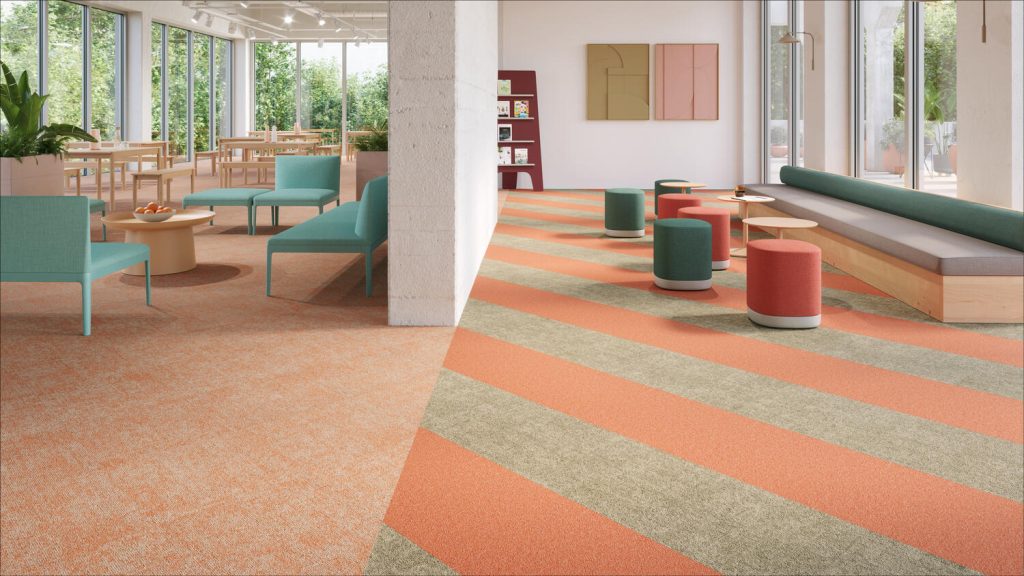
Why Carpet Tile Backing Matters in the UAE
Backing does more than hold the carpet tile together.
It influences dimensional stability, tile-edge behavior, adhesion, moisture response and how easily a tile can be lifted or replaced.
UAE suppliers commonly discuss vinyl-backed, fiberglass-stabilized and other dimensionally stable backing systems. These can be important in air-conditioned buildings where indoor conditions differ sharply from the outdoor environment.
Heavy air-conditioning use and changing humidity conditions make floor preparation and dimensional stability worth close attention.
A moisture-resistant or dimensionally stable backing can reduce some risks associated with moisture exposure, but backing should never be treated as a substitute for proper subfloor assessment.
Moisture in the slab, unsuitable adhesive, poor floor preparation or uncontrolled site conditions can still create installation problems.
For raised-access floors, backing and installation method also matter because tiles may need to remain stable while still allowing planned access to services below.
The practical buying rule is simple: do not specify the face fiber and pattern while treating the backing as an afterthought.
Fire Performance: What ASTM E648 Actually Measures
Terms such as “fire-retardant” are often used in commercial flooring, but they should not be confused with “fireproof.”
No carpet tile should be described as completely fireproof simply because it has passed a reaction-to-fire test.
ASTM E648 is a test used to evaluate how flooring behaves under radiant heat exposure. It measures Critical Radiant Flux, or CRF, at the point where flame propagation stops.
CRF is reported in W/cm².
A higher CRF value is desirable because it indicates that more radiant energy is required to sustain flame propagation.
ASTM E648 Fire-Test Terms
| Term | Plain-English Meaning | Why It Matters |
| Radiant heat exposure | Flooring is exposed to controlled radiant heat | Represents a defined fire-exposure condition |
| Critical Radiant Flux | Heat level measured where flame spread stops | Quantifies resistance to continued flame propagation |
| W/cm² | Unit used to report radiant flux | Allows measured performance to be compared |
| Higher CRF | More energy is required to sustain propagation | Indicates stronger resistance to continued flame spread |
_
EN 13501-1 classifications such as Cfl-s1 may also appear on commercial carpet documentation.
The important point for UAE projects is to review the documentation required by the project rather than assuming that one international test automatically satisfies every approval situation.
Occupancy, consultant requirements, authority expectations and project location can all affect what needs to be submitted.
VOCs and Indoor Air Quality
Indoor-air-quality claims should be based on emissions data rather than vague terms such as “eco-friendly.”
CRI Green Label Plus is one recognized certification program used for carpet, cushion and related products. CRI Green Label Plus documentation states that the program evaluates Total Volatile Organic Compounds (TVOCs) and specific chemicals aligned with CDPH Standard Method requirements.
ASTM Method D5116 provides a controlled chamber-testing method used in emissions assessment.
The cited certification documentation also uses a 14-day measurement period and gives a TVOC benchmark of 0.5 mg/m³ or less for the stated private-office and school-classroom context.
Indoor Air Quality Benchmark
| Item | Benchmark or Test | What It Tells the Buyer |
| Certification | CRI Green Label Plus | Product has undergone defined emissions testing |
| Emissions assessed | TVOCs and specified chemicals | Evaluation goes beyond a generic “low VOC” statement |
| Test method | ASTM D5116 | Emissions are measured using a defined chamber method |
| Measurement period | 14 days | Data is collected after a specified test period |
| TVOC benchmark | ≤0.5 mg/m³ in the stated context | Gives a quantitative emissions reference |
_
Low-emission flooring and adhesives can support indoor environmental quality objectives associated with frameworks such as Al Safat and LEED.
That does not mean a Green Label Plus product automatically secures an Al Safat rating. Flooring is only one part of a much broader building assessment.
The practical procurement approach is to request the current product documentation and evaluate the carpet tile and adhesive system together.
Carpet Tiles and Office Acoustics
Carpet can improve room acoustics, but “soundproofing” is usually the wrong description.
Soft floor coverings can help absorb speech-frequency energy, footfall-related sound and higher-frequency reflections. That can make open-plan offices and meeting spaces more comfortable.
Published RoomTreat data for a heavy carpet-on-pad assembly gives an overall Noise Reduction Coefficient of about 0.55, while the absorption coefficient at 125 Hz falls to about 0.08.
That gap illustrates an important point: acoustic performance varies by frequency.
Carpet may absorb a meaningful amount of mid- and high-frequency sound while doing far less at low frequencies.
Those figures should not be applied directly to every carpet tile. The exact acoustic performance of a selected tile and backing system should come from its own test documentation.
How Much Does Carpet Tile Flooring Cost in the UAE?
UAE carpet tile pricing varies with fiber, construction, backing, quantity, installation method and site condition.
As a practical market reference, the cited UAE supplier data gives these ranges:
| Cost Component | Indicative Range | Important Limitation |
| Polypropylene carpet tile, fitted | AED 45–75/m² | Product tier and project conditions vary |
| Solution-dyed nylon, fitted | AED 85–130/m² | VAT and preparation may be additional |
| Installation labor only | AED 15–25/m² | Assumes a clean, level, ready subfloor |
_
These figures should be treated as market references, not Royal Floors pricing.
Actual quotations can change because of:
- product brand and specification
- fiber and backing
- traffic class
- floor area
- subfloor leveling
- old-floor removal
- adhesive requirements
- working-hour restrictions
- furniture movement
- raised-access conditions
- pattern or tile direction
- difficult access
- irregular room geometry
This is why comparing “price per square metre” alone can be misleading. Two quotations may appear very different until preparation, installation and product specification are separated.
Waste and Lifecycle Cost
Modular flooring can reduce material waste, especially in straightforward layouts.
The cited flooring waste calculator uses approximately 5% waste as a baseline for carpet tile in a straight-lay installation.
More irregular or heavily partitioned office layouts may require roughly 7–10%, while broadloom planning can reach approximately 10–20% depending on room geometry, roll width and pattern considerations.
Those numbers should be used as planning ranges, not fixed allowances.
A measured floor plan and installation pattern should determine the final order quantity.
Carpet tiles can also change the repair economics of a floor.
If one section is stained or damaged, a facility manager may be able to replace individual tiles instead of replacing an entire room.
An AG-Curated lifecycle model estimated $5,000–$15,000 in repair savings over ten years for a particular modeled facility. That is a scenario-specific external model rather than a guaranteed saving for a UAE project, but it illustrates why maintenance strategy should be included in total-cost-of-ownership calculations.
Carpet Tile Procurement Decision Matrix
| Project Condition | Specification Priority |
| Executive office | Appearance, acoustics and suitable commercial class |
| Open-plan office | Durability, acoustics and chair-use compatibility |
| Reception or lobby | Heavy-use classification and appearance retention |
| Hotel guestroom | Comfort, design and appropriate fire documentation |
| Raised-access office | Modularity and dimensional stability |
| Sustainability-led project | VOC documentation and environmental data |
| Irregular floor plan | Waste planning and modular layout |
| Damage-prone area | Replaceability and spare-tile strategy |
_
This framework is not a regulation. It is a practical way to decide which technical characteristics deserve the most attention in different types of projects.
Carpet Tiles vs Broadloom
Carpet tiles and broadloom solve different design and operational problems.
| Factor | Carpet Tile | Broadloom |
| Localized replacement | Strong advantage | Often requires larger-area replacement |
| Access below flooring | Potentially easier | Usually more disruptive |
| Waste in irregular layouts | Often lower | Often higher |
| Surface appearance | Modular joints may be visible | More continuous appearance |
| Design flexibility | High | Product dependent |
| Repair strategy | Tile-by-tile | Larger sections may need replacement |
| Installation planning | Modular | Roll width and seams matter |
_
For many offices, modular replacement and lower disruption are compelling.
Broadloom can still be appropriate where continuous surface appearance, hospitality aesthetics or particular design goals are more important.
The correct choice is therefore not “carpet tile is always better.” It is the flooring system that best matches the project’s use, appearance, maintenance and lifecycle requirements.
How to Specify Carpet Tile Flooring for a UAE Project
A disciplined specification process can prevent many purchasing mistakes.
- Define the Traffic Level
Identify whether the space is a low-use meeting room, normal office, busy reception, public corridor or intensive commercial area.
Then match the product to an appropriate tested use classification.
- Check Fiber and Construction
Confirm fiber type, pile construction, pile weight, backing and relevant technical performance. Do not specify a product simply because it says “nylon” or “commercial.”
- Review Fire Documentation
Check the actual reaction-to-fire documentation requested for the project. Where ASTM E648, EN 13501-1 or another classification appears, confirm that the documentation belongs to the exact product being proposed.
- Review VOC Documentation
For projects with indoor environmental quality requirements, check emissions documentation for both the tile and relevant installation products.
- Review Backing and Subfloor Conditions
Confirm floor readiness, moisture conditions where relevant, dimensional stability and compatibility with any raised-access system.
- Compare Total Fitted Cost
Separate material, installation and preparation costs.
A lower tile price does not necessarily mean a lower finished project cost.
- Plan for Future Replacement
Where practical, consider keeping compatible spare tiles for future localized replacement.
For projects specifically focused on the capital, Royal Floors also has a dedicated guide to carpet tile installation in Abu Dhabi.
Pre-Installation Checklist
Before installation begins, confirm:
- measured floor area
- waste allowance
- floor flatness and readiness
- moisture conditions where relevant
- removal of existing finishes
- tile direction or pattern
- approved adhesive system
- raised-access-floor requirements
- door and transition clearances
- skirting details
- furniture movement
- work-hour restrictions
- technical documents required by the consultant or project authority
- quantity of spare material to retain
For boardrooms, hospitality interiors or complete office schemes where flooring is being coordinated with window treatments, luxury curtains may also form part of the overall acoustic and visual interior package.
Frequently Asked Questions
What is carpet tile flooring?
Carpet tile flooring is a modular textile floor covering supplied as individual tiles rather than one continuous roll. The modular format makes damaged or stained sections easier to replace and can simplify access, maintenance and phased refurbishment in many commercial interiors.
How much does carpet tile flooring cost in the UAE?
The cited UAE supplier data places fitted polypropylene carpet tiles at about AED 45–75/m² and fitted solution-dyed nylon at about AED 85–130/m². Installation-only labor is cited at approximately AED 15–25/m² for a clean, ready and level subfloor. Final quotations depend on product and site conditions.
Is nylon better than polypropylene for commercial carpet tiles?
Not automatically. Nylon is widely used in demanding commercial applications and holds the largest material share in the cited global carpet tile market, while polypropylene is generally positioned at a lower price point. The correct choice still depends on traffic class, construction, backing and tested performance.
What carpet tile class is suitable for an office?
EN Class 32 is associated with medium-commercial applications such as offices, while Class 31 covers lighter commercial use and Class 33 is intended for intensive commercial traffic. The appropriate class should match the actual traffic and application rather than being selected by office type alone.
Are carpet tiles fireproof?
No. Carpet tiles may carry documented reaction-to-fire classifications or test results, but that does not make them fireproof. ASTM E648, for example, measures flooring behavior under radiant heat through Critical Radiant Flux.
Are carpet tiles suitable for raised-access floors?
They can be well suited to raised-access environments because modular tiles may allow easier access to services below. The tile construction, dimensional stability, installation method and raised-floor system still need to be checked for compatibility.
Do carpet tiles improve office acoustics?
Carpet tiles can help absorb footfall, speech-frequency sound and room reflections, but they do not make a room soundproof. Exact acoustic performance varies by tile, backing and floor assembly and should be confirmed from product-specific test data.
How much extra carpet tile should be ordered for waste?
Around 5% can be a useful starting point for straightforward straight-lay spaces, while irregular or heavily partitioned layouts may require approximately 7–10%. Final waste allowance should be based on the measured floor plan, tile direction and installation pattern.
Final Specification Principle
Carpet tile flooring should be specified as a complete system, not purchased as a color sample.
Traffic classification, fiber, pile construction, backing, fire documentation, VOC emissions, subfloor preparation, installation method, waste planning and future maintenance all affect the result.
That approach is particularly important in commercial UAE projects, where the lowest initial material price may not deliver the lowest installed or lifecycle cost.
If you are planning an office, hospitality or commercial flooring project, Royal Floors can help you compare carpet tile options, review project requirements and prepare a supply-and-installation quotation based on the actual floor area and site conditions.
Related Royal Floors Resources
Carpet Flooring · Raised Access Flooring · Our Projects · Royal Floors